
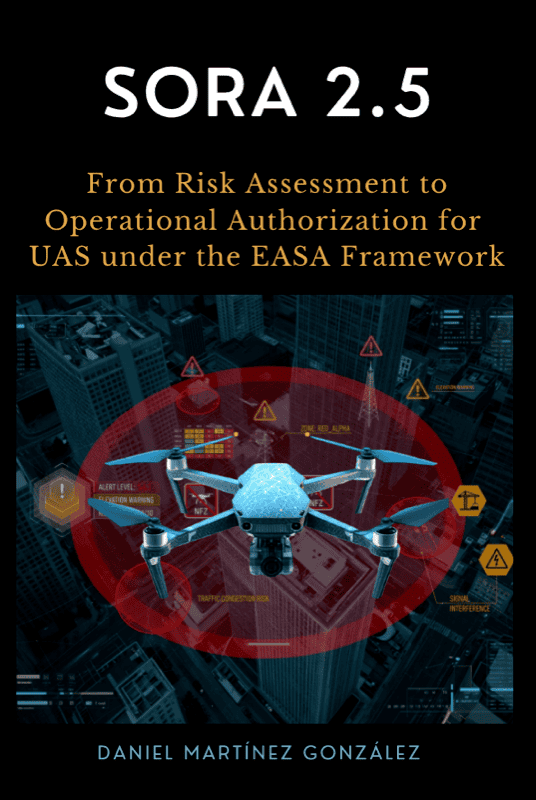
SORA 2.5
From Risk Assessment to Operational Authorization for UAS under the EASA Framework
ISBN:
9788409887880
Legal Deposit:
M-17029-2026
SafeCreative:
SC-2026-2607066303274
Pages:
340
Dimensions:
9" x 6"
Language:
English
Full Description
Do you need authorization to operate in the Specific Category? Whether BVLOS, flight over populated areas, controlled airspace, or special operations, SORA 2.5 is the regulatory methodology every UAS operator must master in Europe.
Written for professional operators, certifiers, engineers, and regulators, this book is your definitive guide to applying SORA 2.5 in real EASA markets: Spain (AESA), France (DGAC), Germany (LBA), and Italy (ENAC).
CHAPTER 1 — Regulatory History and Evolution
- From SORA 1.0 to SORA 2.5: key methodological changes.
- European regulatory framework: EASA, Royal Decree 517/2024.
- Evolution of categories: Open → Specific → Certified.
- Context: why SORA has been mandatory since 2024.
CHAPTER 2 — SORA 2.5 Fundamentals
- ConOps (Concept of Operations): strategic documentation.
- GRC vs ARC: two independent dimensions of risk.
- OSOs (Operational Safety Objectives): 24 requirements per SAIL.
- SAIL I/II/III: table of technical and documentary requirements.
- Complete flow: ConOps → Evaluation → Authorization.
CHAPTER 3 — Scenario Analysis
- PDRA: 5 standard scenarios (S01, S02, G01-G03).
- Operational characterization: area, altitude, speed, proximity.
- Practical cases: agricultural mapping, line inspection, photogrammetry.
- Compatibility: when you can use standard scenarios.
CHAPTER 4 — Risk Assessment (GRC)
- Threat matrix: identification, severity, probability.
- GRC calculation (1-4): step-by-step procedure.
- Strategic vs tactical mitigations.
- TMPR: Tactical Mitigation Performance Requirements (quantifiable specification).
CHAPTER 5 — SAIL: Assurance Levels
- Reference table: 24 OSOs with requirements per SAIL.
- Interpretation: what each level means (L/M/H).
- Personnel certifications: required RPAS licenses.
- Technical documentation: manuals, procedures, SOP.
CHAPTER 6 — European Markets
- Comparative analysis: AESA vs DGAC vs LBA vs ENAC.
- Submission procedures by country.
- Additional country-specific documentation (language, formats).
- Typical response times: 15-30 days AESA, 30-60 DGAC.
- Key concept: SORA is identical across all countries; only presentation changes.
CHAPTER 7 — Use Cases by Sector
- Agriculture: multispectral mapping, phytosanitary operations.
- Inspection: power lines, bridges, pipelines.
- Photogrammetry: cartography, 3D models.
- Security: surveillance, patrols, events.
- Critical infrastructure: energy, telecommunications.
CHAPTER 8 — Templates and Documentation
- Responsibility matrix: Operator / Training Organization / Designer.
- AESA submission template: structure and minimum content.
- Operational Plan: fully annotated example.
- RFI (Request for Information): how to respond correctly.
- Pre-submission checklist: 50+ points to avoid rejections.
APPENDIX A — Diagrams and Reference Tables
- Complete SORA 2.5 decision flow: from operational concept to approval.
- SAIL requirements matrix: OSOs by level (L/M/H) and operation category.
- Comparative table of European authorities: procedures, documentation, contacts.
APPENDIX B — Quick Reference
- Technical acronyms and definitions: GRC, ARC, SAIL, PDRA, TMPR, OSO, ConOps, and 150+ terms.
- Official contacts for EASA authorities: AESA, DGAC, LBA, ENAC, EASA (URLs, emails, phones).
- Live links to European regulations: EU Regulations 2019/945 and 2019/947, EASA technical guidance, special conditions.
APPENDIX C — Real Submission Examples
- AESA submission template completely annotated step by step.
- Operational Plan (POE): structure, requirements, and how to draft it.
- Risk Assessment (GRC): complete threat matrix with examples.
- Response to RFI (Request for Information): strategies and effective writing.
APPENDIX D — OSOs and SAIL Levels Reference
- Reference matrix: 24 OSOs crossed with SAIL I/II/III.
- Interpretation: what each requirement implies by level.
- Verification matrix: pre-submission verification.
- Regulatory references associated with each OSO.
- 50+ point pre-submission checklist to avoid rejections.
KEY FEATURES:
- EU Regulations 2019/945 and 2019/947 and EASA/AESA guidance 2025/2026.
- 5 flow diagrams and 8 reference tables.
- Annotated real submission examples.
- Integrated practical case: railway line inspection (4 countries).
WHO IS THIS FOR?
- UAS operators requesting SAIL II/III authorization.
- Certifiers and regulatory advisors.
- Engineers designing UAS systems.
- Authorities implementing local regulations.
- Aeronautical robotics students.
If you need authorization in the Specific Category in Europe, this book saves you months of searching through scattered regulations and shows you exactly what documentation each national authority expects.
Share