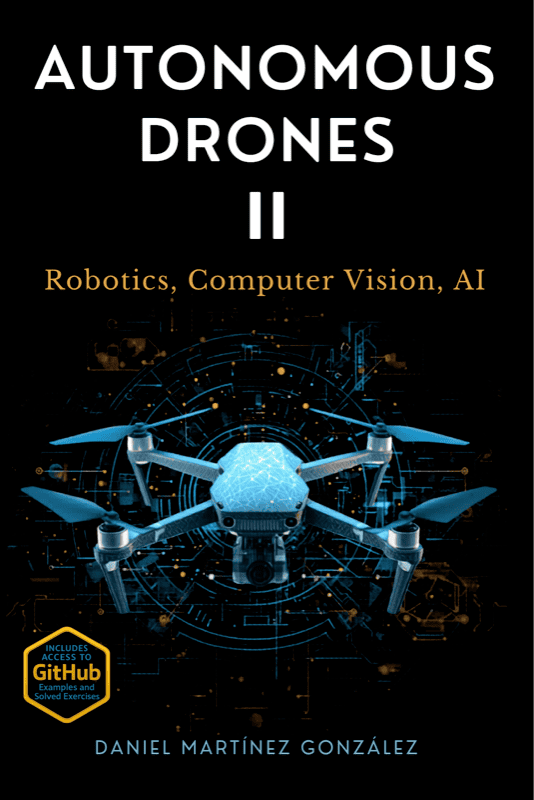
Autonomous Drones II
Robotics, Computer Vision, AI
ISBN:
9788409871711
Legal Deposit:
M-14881-2026
SafeCreative:
SC-2026-2605145656280
Pages:
246
Dimensions:
9" x 6"
Language:
English
Full Description
You have mastered the fundamentals (Volume 1). Now it is time to take it to the next level: intelligent autonomy.
This book teaches you how to integrate robotics, computer vision, and artificial intelligence into real drones. Perfect for engineers looking to specialise in autonomous perception.
CHAPTER 1 — ROS2 and Robotic Architecture
- The standard operating system in professional robotics.
- Nodes, topics, messages — decentralised architecture.
- Ardupilot + ROS2 integration (MAVLink bridge).
- Nav2: 3D autonomous navigation stack.
- Simulation with Gazebo + SITL.
CHAPTER 2 — Computer Vision and Object Detection
- OpenCV: real-time image processing.
- YOLOv8: ultra-fast detection (45 FPS on GPU).
- Classical methods vs. Deep Learning.
- Integration with ROS2 (image publishers/subscribers).
- Real-world use cases: detection of people, vehicles, points of interest.
CHAPTER 3 — AI in Drones
- Edge Computing: processing on the drone, not in the cloud.
- Jetson line (Nano → Orin): selection based on latency and budget.
- Latency < 100ms: mandatory for autonomous flight.
- TensorRT: 2-3x acceleration of NN models.
- Complete architecture: Jetson + ROS2 + Ardupilot + vision.
APPENDICES
- APPENDIX A1: GitHub Guide - Project structure, branches and workflow.
- APPENDIX A2: C++ for Robotics - Advanced concepts, optimization and ROS2 libraries.
KEY FEATURES:
- 246 pages of applied content.
- Ready-to-use Python/C++ code.
- 20+ graphs and flow diagrams.
- Compatible with hardware: Jetson Nano, Orin NX, RTX.
- Preparation for research/commercial drones.
PREREQUISITES:
- Familiarity with Python (Appendix A2).
- Drone concepts (Volume 1).
- Ubuntu 22.04 recommended.
WHO IS IT FOR?
- Engineers specialising in robotic autonomy.
- Researchers in computer vision.
- AI drone startups.
- Makers who want "intelligent" drones.
From object detection to autonomous decision-making, you will learn the complete stack of intelligent drones.
Share